
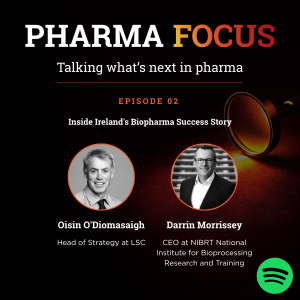
🎧 This is Episode 2 of Pharma Focus, the LSC podcast bringing you the real conversations shaping Ireland’s life sciences industry.
Listen to the full episode here: https://bit.ly/4vGZkl0
In 2006, Ireland had a handful of biologics facilities and a government willing to bet on more. Today there are twenty five. That kind of growth does not happen by luck. Someone has to build the infrastructure before the industry asks for it, then spend twenty years proving it was worth it.
In this episode of Pharma Focus, host Oisin O’Diomasaigh sits down with Dr Darrin Morrissey, CEO of NIBRT, the National Institute for Bioprocessing Research and Training. They talk about how that bet paid off, what NIBRT is doing to keep it paying off, and the one problem Darrin admits the sector has not solved yet.
From the Bench to the Boardroom, the Long Way Round
Darrin did not set out to run a national institute. He trained as a scientist at UCC and completed a PhD in cancer biology, realising along the way that a life at the bench was not where he was headed. Close to twenty years in pharma followed. He moved through clinical research, regulatory affairs and commercial roles, including a long run with GSK in oncology at national, European and global level.
A left of field move into manufacturing strategy pulled him closer to the plant floor. Then came a bigger jump. He left industry entirely for public research funding, first at Science Foundation Ireland, then at the Health Research Board, before NIBRT came calling six years ago. He calls it the perfect landing ground, deep industry experience meeting a real understanding of how public funding actually works.
That combination shows up throughout the conversation. Darrin talks about manufacturing the way someone who has lived it does, and about state investment the way someone who has had to justify it does.
Five Thousand People a Year, and a Very Different Mix
NIBRT’s mission has not moved since it was set up around 2006, to strengthen Ireland’s position as a location of choice for the manufacture of biologic medicines. What has changed is who walks through the door to make that happen.
Darrin breaks NIBRT into three parts. There is the facility, a simulated GMP environment he calls genuinely unique globally. There are the people, who design and deliver training and lead research. And there is the knowledge that comes out of both, curriculum on one side, manufacturing solutions on the other.
The training runs on a spectrum. At one end sits the NIBRT Online Academy, a starting point rather than a route straight to the factory floor. At the other end sits highly customised training built around one company’s exact equipment and processes. In between, NIBRT partners with nearly every university in the country, with Atlantic Technological University hosting the largest number of joint courses. Increasingly, it also supports people arriving from outside life sciences altogether through Springboard Plus and Skillnet funding.
NIBRT now trains five thousand people a year, and the mix has changed. Darrin tells Oisin about a company visit where a senior manufacturing executive asked a group of new trainees where they had come from. One had been a truck driver. One had been a hairdresser. One had driven a taxi. None had a life science background, and the company had chosen to hire that way deliberately. It is, Darrin says, becoming less of an exception and more of a pattern.
Building Credentials That Actually Stack
Micro credentials are gaining ground across further education, and NIBRT has built its own version. The NIBRT Global Qualification, developed with Atlantic Technological University through the European credit transfer system, lets company specific training accumulate into a recognised qualification instead of disappearing into a certificate nobody outside the company recognises.
It launched around eighteen months ago, so it is early days. Darrin already sees interest from large multinational companies and from regulators, which matters in a sector where every step is judged against GMP standard.
What Ireland Got Right, and What NIBRT Actually Added
Ask Darrin why Ireland pulled ahead in biologics manufacturing and he starts with IDA Ireland’s strategy from the 1990s, competitive tax, a strong delivery record, and a steady supply of graduates. NIBRT’s job was to add the piece still missing, GMP capability. In the early days, it operated as a finishing school, taking life scientists straight out of college and giving them the practical grounding industry needed.
He is careful not to claim NIBRT built the sector alone. He is just as clear that without it, Ireland’s ecosystem would be a noticeably weaker version of itself.
Six Asks for the National Strategy
The Department of Enterprise is building Ireland’s national life science strategy, and NIBRT made a formal submission before Christmas. Darrin lays out six priorities. Reinforce Ireland’s existing strength as a stable, resilient manufacturing hub. Commit to a real step change in research funding for biopharma and biotech manufacturing. Back Ireland to lead in advanced manufacturing powered by AI, digital tools and robotics. Position the country as a genuine leader in advanced therapies and next generation biologics. Grow indigenous biotech startups and SMEs rather than relying on foreign direct investment alone, an area Darrin thinks Ireland is underplaying, citing a BioPharmaChem Ireland report covering around 130 companies already active in the space. And make full use of Ireland’s EU membership, with the country holding the EU presidency from July and the EU Biotech Act advancing over the following six months.
Two of those six get the most airtime in the conversation, indigenous biotech and advanced therapies. That is not a coincidence. They are the areas where Darrin thinks Ireland has built the foundation but not yet built the outcome.
Why the Timeline Slipped
This is the part of the conversation where Darrin stops sounding like a strategy document and starts sounding like someone solving a real problem. A few years ago, IDA backed a substantial investment to orientate NIBRT’s facility toward cell and gene therapy manufacturing. He is candid that the sector, and NIBRT with it, expected to be further along by now than it actually is.
The issue is not the science. It is manufacturability. Cell therapy in particular still carries real uncertainty in how it is made at scale, and that uncertainty drives up cost, which limits how many patients can access the treatment. Darrin borrows a line from Sarah O’Keeffe at Eli Lilly to describe it, the gap between the lab and manufacturing. It is a phrase that sticks, because it names something the industry has been circling without quite saying out loud.
Closing the Gap
NIBRT is attacking that gap on three fronts. Cell and gene therapy, both viral and non viral. Oligonucleotides, where mRNA manufacturing is often assumed to be solved but thermostability issues remain. And advanced antibody formats, including conjugates and multi-specifics, which carry their own unresolved manufacturing questions.
Some of that work happens in NIBRT’s Concept Facility, a Research Ireland funded space built for pre-GMP manufacturing questions, ironing out process kinks before anything reaches GMP scale up. NIBRT has also brought in two new principal investigators, Sakis Mantelaris from Georgia Tech and Mark Smales from the University of Kent. It is now part of two newly announced RIN research centres too, one focused on cell therapy manufacturing, the other on gene therapy, mRNA and viral vector manufacturing more broadly. Darrin calls it a lasting competitive advantage for Ireland, if the sector can crack it in the next few years. The word if is doing real work in that sentence.
The Threat Is Not Dramatic, It Is Just Competition
Asked what could derail Ireland’s position over the next decade, Darrin does not reach for a single crisis. He points to something simpler, the world has become more competitive. Reinvestment in US biomanufacturing capability is real, and other countries are chasing the same opportunity Ireland identified decades ago.
His fix is not dramatic either. Stay focused on infrastructure, competitiveness and the consistent quality of delivery that built Ireland’s reputation in the first place. Pushed to name one priority for the national strategy, he does not choose a funding line. He chooses appetite, a genuine national willingness to take on risk, because biotech rewards patience more than it rewards caution.
Stay Curious
Asked what advice he would give someone starting out in life sciences today, Darrin admits he is an odd person to ask. His own career did not follow a plan. It moved in pivots, reverse pivots and left turns. The advice he lands on is less a roadmap and more a mindset: be curious. Read the state of the art, talk to the people building it, and treat every new development as something to engage with rather than wait out.
It is advice that matches what NIBRT’s own careers event shows every year. Now in its twelfth year, it draws PhD graduates and people with no life science background at all, all looking for the same thing, a way in.
Ireland’s biopharma story so far has been about building infrastructure before the demand fully arrived. Darrin’s conversation makes clear the next chapter will not be won the same way. It will be won by closing the gap between what Ireland can research and what Ireland can actually manufacture at scale, and that is a harder, slower kind of progress than building a facility.
Follow Pharma Focus so you do not miss an episode. If you have a story or perspective worth exploring on the show, get in touch at [email protected]
As Ireland’s biopharma sector continues to grow, the conversation around sustainability, safety and manufacturing readiness is only getting louder. We explored a related theme in our first episode: 👉 https://lscconnect.com/blog-irish-biopharma-sustainability-2026/