
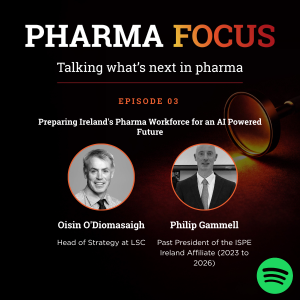
🎧 This is Episode 3 of Pharma Focus, the LSC podcast bringing you the real conversations shaping Ireland’s life sciences industry.
In the nineties, Philip Gammell set up the first animal cell bioreactors in Ireland and made a coronavirus vaccine for dogs before anything like it existed for humans. It is the kind of detail that sounds like a footnote until you realise it says everything about how long this industry has been quietly innovating, often well ahead of the moments the wider world notices.
Philip has spent more than three decades across manufacturing, validation, tech transfer, project management and energy systems, and has recently completed his term as President of the ISPE Ireland affiliate, the first person from Kerry to hold the position, a fact he is proud to mention. In this episode of Pharma Focus, he speaks openly about where the industry has genuinely changed, where it has stayed remarkably the same, and where Ireland needs to be paying closer attention.
From Veterinary Vaccines to Digital Transformation
Philip’s route into pharma was not a straight line. He graduated during a difficult economic period in Ireland, when most of his classmates emigrated or went straight into postgraduate study. He was one of the few to land a job, and it happened to be making veterinary vaccines.
That early experience in biotechnology gave him a grounding across drug product, small molecule fill finish, oral solid dosage and aseptic processing, before he moved into validation, capital programmes, global engineering, energy systems and, most recently, digital transformation. It is a career that has touched almost every corner of the industry, and it gives real weight to his view on what has actually changed over thirty years.
His answer might surprise people outside the sector. The core knowledge needed to manufacture medicines safely has barely shifted. What has changed is how work gets recorded, shared and acted on. A decade ago, most of the industry still ran on paper. Today, digital systems dominate, and communication happens at a completely different speed. That is the real transformation, more than any single new technology.
What ISPE Ireland Actually Does
For anyone unfamiliar with ISPE, Philip gives a clear breakdown. The International Society for Pharmaceutical Engineering is a global, not for profit organisation representing life sciences professionals worldwide, with more than 25,000 members across over 50 affiliates. Despite the name, it is not just for engineers. It is for everyone working across the industry.
The Irish affiliate, founded in 1989, is one of the strongest in the network. Per capita, it is the biggest affiliate globally, and it was named International Affiliate of the Year in 2023. With over 60 volunteers and close to 800 members, it runs more than 20 events a year across eight subcommittees, built around three pillars: knowledge, community and innovation.
One initiative Philip highlights is a new forum being formed for senior quality leaders, created specifically so people can discuss the harder, less resolved questions, like what AI genuinely means for their function and their company, openly and under Chatham House rules. It is a good example of ISPE Ireland trying to get ahead of a conversation the industry has not yet had in full.
Where AI Fits, and Where It Does Not Yet
Ask ISPE Ireland’s members what dominates their conversations, and the answer is consistent: digital transformation, Industry 4.0 and 5.0, and increasingly, artificial intelligence.
Philip is candid about where the uncertainty sits. Current regulatory guidance for GxP environments is intentionally conservative, built around deterministic, explainable outputs. AI, by contrast, often works probabilistically, which makes validation genuinely difficult. As Philip points out, even the people building these systems admit they do not fully understand what happens under the hood, which makes it harder still to explain to a regulator.
The result is a strange middle ground. AI is already widely used across non GxP activities, yet its place in anything tied to critical quality decisions remains an open question, one that varies by region and by company.
The Question Nobody Can Answer Yet
Perhaps the most striking part of the conversation is Philip’s admission that nobody, including senior industry leaders, has a confident answer to what pharma jobs will look like in five years.
He offers a useful lens for thinking about it. A QA specialist today might evolve into someone validating AI systems. A production operator might become a process optimisation specialist. The skills required are shifting from purely technical or purely digital toward a hybrid of both.
This matches what LSC sees directly in the market. Clients are rarely asking for an AI specialist to be dropped into a regulated pharma setting with no process background. What they want is process knowledge first, layered with digital and data capability. Understanding GMP and the science behind a drug remains the foundation. AI fluency is what gets built on top of it.
What Makes Us Different From the Machines
Philip’s advice for professionals is practical rather than dramatic. He points to three human strengths that AI still cannot replicate: curiosity, creativity and communication. AI is improving at communication, but genuine curiosity and creative problem solving remain distinctly human, and he believes protecting that is what will keep people relevant.
His suggestion for anyone with just one hour a week to invest is simple. Read. Listen to podcasts. Stay informed on what is happening both inside and outside the industry. And, in his words, put the phone down and get off social media occasionally too. It is not glamorous advice, but it is grounded in decades of watching an industry evolve.
Is Ireland’s Education System Keeping Pace
Here, Philip is more critical. Traditional third level courses, in his view, are still largely built on curricula developed long before AI became a boardroom priority. There are bright spots, though. He highlights a new course launching at the University of Limerick this September, a four year programme in immersive bioscience and biotherapeutics that runs 40 weeks a year and includes two years of paid industry placement, structured around workshop based, practical learning rather than the traditional lecture model.
It is exactly the kind of departure Philip believes the sector needs more of, alongside a genuine push toward apprenticeship style learning routes.
Ireland’s Position: Strong, But Not Guaranteed
Despite the challenges, Philip remains confident in Ireland’s standing. Strong infrastructure through NIBRT and PMTC, consistent government support through IDA Ireland and Enterprise Ireland, and a well established education system all give the country a solid base.
A 2024 report from the Expert Working Group on Future Skills projected a need for an additional 15,000 to 20,000 people in Irish biopharma over the next five years, with a potential shortfall of around 3,000 people annually through traditional graduate routes alone. What that report could not yet quantify is the impact AI will have on that projected demand, something Philip candidly describes as the elephant in the room.
He also raises a point that goes beyond skills entirely. Ireland’s life sciences success is closely tied to multinational investment, which brings huge benefit but also real exposure to geopolitical risk, something last year’s tariff disruption made clear. His view is that Ireland needs to build a stronger indigenous industry and start generating more of its own intellectual property, rather than largely supporting IP developed elsewhere, if it wants a more resilient long term position.
His message to policymakers currently shaping the National Life Sciences Strategy is clear. Alongside investment in cell and gene therapy and a stronger push toward Irish generated IP, the country needs an honest roadmap comparing today’s job functions with what they might look like once AI is fully embedded, ideally within the next six to nine months, not years.
A Reminder That Some Things Won’t Change
One of the most grounding moments in the conversation is a reflection on an industry quote Philip paraphrases: everyone asks what is going to change, but rarely what is going to stay the same.
Small molecule manufacturing is a good example. Written off by some as a legacy business, it remains central to newer modalities like antibody drug conjugates, and Ireland’s continued investment in facilities such as Novo Nordisk’s tableting plant in Athlone shows the fundamentals of pharma manufacturing are far from obsolete.
Building INSPIRE From Scratch
Philip’s final event as President was INSPIRE, and the story behind it is worth telling on its own. The idea was conceived at an ISPE Ireland strategy meeting, modelled on the ISPE Boston product show after Gary O’Brien attended it and suggested Ireland take on something similarly ambitious. They chose Cork, and made a deliberate decision to keep it free, covering costs through vendor sponsorship, specifically to remove the barrier that usually keeps students and emerging professionals away from industry events.
The event also included a careers fair, run in partnership with NIBRT, designed to cover the southern and western regions that NIBRT’s own long running Dublin event does not reach as effectively. It is a small but telling example of ISPE Ireland building something with the full ecosystem in mind, students, graduates, vendors, academia and established professionals alike, rather than any one group in isolation.
Philip has now handed the chairmanship to Adrian, who steps in with several years already served as vice president.
Some Closing Advice
Asked what he would tell a graduate or a mid career professional building a future in pharma, Philip’s answer is simple. It is a fantastic industry, and he has never regretted a day in it. Learning does not stop once you finish a degree. Stay curious, stay creative, keep communicating, and keep upskilling, because that mindset applies just as much to people decades into their career as it does to anyone just starting out.
Listen to the Full Episode
This is just a glimpse of a wide ranging conversation with Philip Gammell on Pharma Focus. Listen to the full episode wherever you get your podcasts, and follow LSC on LinkedIn for more insight from across the biopharma and life sciences industry. Listen to the full episode here: https://creators.spotify.com/pod/profile/lsc1/episodes/Episode-3—Preparing-Irelands-Pharma-Workforce-for-an-AI-Powered-Future-e3mv5s0