
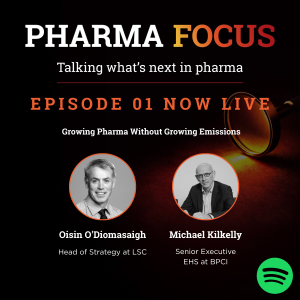
🎧 This is Episode 1 of Pharma Focus, the LSC podcast bringing you the real conversations shaping Ireland’s life sciences industry.
Listen to the full episode here: htps://creators.spotify.com/pod/show/5kooOYWfRpdjc9ZX7BqQeq/home
What does it actually take to grow one of Europe’s most successful industrial sectors while reducing its environmental impact at the same time? That is the question at the heart of our first episode of Pharma Focus, where host Oisin O’Diomasaigh sits down with Michael Kilkelly, Senior Executive for Environmental Health and Safety at BioPharmaChemical Ireland.
Michael is Senior Executive for Environmental Health and Safety at BioPharmaChemical Ireland, the sectoral body representing around 80 pharma, biotech and chemical member companies in Ireland. But before that role, he spent decades inside the industry itself. He graduated from UCC with a chemistry degree in 1989, worked as a discovery chemist in England, came back to do a PhD focused on process safety, and then spent years in contract manufacturing scaling up 25 different chemical processes. He went on to work at Pfizer’s process development centre in Ringaskiddy before spending close to 16 years at Recordati, the last eight of which as plant manager. He also designed pharma industry courses at UCC before joining BPCI two years ago.
That background gives Michael a perspective that spans the full journey of a pharma career, from the lab to the boardroom.
From Manufacturing to Sector Leadership
One of the first things Oisin asks Michael is what the shift feels like, going from the tight cadence of manufacturing to a role where he looks across the entire biopharma sector in Ireland and beyond.
Michael’s answer is honest. The phone does not ring at three in the morning anymore. But more than that, the role gives him space and access he never had before. He now taps into a network of expertise across 80 member companies, sits in rooms with regulators and government departments, and travels to Brussels twice a year to discuss the impact of European regulation on Irish industry. It is, by any measure, a very different kind of job.
The 2026 Sustainability Report: What It Says and What It Means
The conversation is anchored in BPCI’s Sustainability and Responsible Care Report 2026, launched in March of this year. Michael was one of its principal authors and his core message is simple: engage early and engage often. With peers, with regulators, with industry bodies. In short, the more connected the sector is, the better it performs.
The headline finding in the report is what Michael describes as exports and emissions moving in opposite directions. Ireland’s biopharma sector grew its exports by 30% over the reporting period while also cutting CO₂ emissions from electricity by 30%. In most industries, growth and emissions reduction rise together. Here they are pulling apart, and that is a significant shift.
Three things are driving it. The first is a shift away from high volume, lower value products toward low volume, high value medicines. Less energy intensity per unit of output. The second is serious investment in on-site renewable energy — 48 sites spent a combined €150 million on generating their own green electricity. The third is sourcing. 69% of member companies are now getting 100% of their electricity from certified green suppliers.
Michael is also clear that regulation has played a role. Tough requirements from bodies like the HSA and EPA pushed the industry to develop better containment measures. The intention of regulation, he says, is always good. Where it runs into trouble is when it becomes too complicated over time. He welcomes the current EU move toward simplifying the CSRD rather than deregulating it. The goal, as he puts it, is to make regulation fit for purpose for both sides.
The Uncomfortable Number: Hazardous Waste Up 16%
Not everything in the report is positive and Michael does not pretend otherwise. Hazardous waste across the sector increased by 16% over the same period that everything else improved. The main driver is solvents.
The reason connects directly to Ireland’s commercial success. The growth in GLP-1 medicine manufacturing, the increase in contract manufacturing activity and the rise of complex multi-product API sites have all pushed solvent usage higher. When a site is running multiple different processes, sorting waste for recycling or repurposing becomes much harder.
BPCI is not leaving this as an open problem. Michael talks about active conversations with the EPA around establishing a dedicated GMP solvent recovery business in Ireland, modelled on operations that already exist in France and Germany. The concept involves taking solvents from API manufacturers and recovering them to GMP standard. Two companies are already showing serious interest. It is an early stage conversation but the direction is clear.
Balancing Production with Environmental Responsibility
Oisin asks Michael directly about something many plant managers face: how do you balance the relentless cadence of production with the longer-term work of reducing environmental impact?
Michael’s answer comes back to three non-negotiables he kept front of mind throughout his years in manufacturing. Safety of the person. Safety of the environment. Safety of the patient. Every decision gets tested against those three things first. Everything else, he says, is relatively easy after that.
On the practical side, he talks about energy mapping — understanding exactly where your site uses energy, finding the spikes and targeting them. He gives a specific example of clean rooms, which can account for 20 to 30% of a site’s total energy usage and are often run continuously. He describes challenging the validated air change regimes in those rooms, working with quality teams to ask whether the same GMP standards could be maintained at lower air change rates.
That point about working with quality teams is one he comes back to. Sustainability cannot sit in a silo owned by EHS and facilities managers. It has to be a conversation across functions. Michael has gone out of his way to speak about sustainability at QP forums and PDA conferences, places where quality professionals gather. The feedback, he says, has been genuinely positive.
Safety: What the Numbers Do Not Show You
The report shows that lost-time injury rates went up slightly while severity came down. That sounds contradictory until Michael explains how to read it.
Lost-time injury rate is what he calls a lagging indicator. It tells you what already happened. What the sector needs to move toward is leading indicators — metrics that signal risk before incidents occur. It is the same mindset shift as moving from preventative maintenance to predictive maintenance, applied to people and process safety.
Michael also raises something more direct. Remote and hybrid working has reduced the physical presence of safety professionals on the plant floor, and that has real consequences. In his view, the best way to manage process safety is to walk, touch and talk. To be present. To speak to operators and maintenance crews and understand what is actually happening rather than relying solely on documentation.
On top of that, the issue of paperwork comes up. When 90% of a safety professional’s time is consumed by documentation and only 10% is spent physically on site, something has gone wrong. As a result, BPCI is working with regulators to find ways to speed up documentation processes and free people up to be where they are most needed.
The 2008 Explosion That Changed the Sector
One of the most powerful moments in the episode is when Michael talks about a tragic explosion at a company called Corden in Little Island, Cork, in 2008. One operator lost his life. Another was severely injured. The plant was shut down and the incident had a ripple effect across the entire Irish pharma sector.
That incident was the founding moment of BPCI’s Process Safety Group. And now, BPCI is hosting an event where the chief inspector who investigated the explosion will walk attendees through the full story, from the moment he received the call to the legal, financial and human consequences that followed.
The reason for doing this is straightforward. Complacency grows in the gap between incidents. When nothing has gone wrong for a long time, it becomes easy to treat risk as abstract. Bringing this story back into the room, with the people who lived it, is a way of keeping process safety real.
What Makes Ireland Genuinely Different
Perhaps the most striking part of the conversation is Michael’s description of what happens inside a BPCI members’ meeting. Competitors sit in the same room and share information openly. Technical knowledge, regulatory experience, lessons learned from near misses. No IP is shared and there are strict rules about anything that could affect the market. But everything else flows freely.
Michael has worked with companies from across Europe and the United States. He says people from those countries are consistently perplexed by it. The level of openness, the access to regulators outside of inspection environments, the fact that someone can pick up the phone to a competitor and get an honest answer. It does not exist in most places.
BPCI operates as a membership-driven organisation. The executives do not set the agenda. They go out to members and ask what they need, what is worrying them, what they want to discuss. Then they facilitate it. That model is what keeps the collaboration genuine.
Advice for Young Chemists and Engineers
Oisin and Michael both have children thinking about careers and the conversation turns naturally to advice for young people entering the life sciences sector.
Michael’s guidance is practical and specific. Go and work for a contract manufacturer early in your career. You will learn fast, take on real responsibility quickly and deal with processes that are not yet mature, which means you get to shape them. On top of that, you will develop a sharper understanding of environmental and safety impact than you would in a more established single-product environment.
If you get the chance, working for a small start-up is worth it too. You will wear many hats and that broader perspective will serve you throughout your career.
On sustainability specifically, Michael says the mindset shift that matters most is stopping treating it as a separate topic. Sustainability has to be embedded in everything, from how processes are designed to how products are packaged. He is encouraged to see life cycle analysis now being built into third-level chemistry and engineering programmes. The next generation is starting with a different frame of reference.
He also quotes a former boss who told him to change career every five years for the first twenty years. Not just change jobs. Change career. Keep an open mind. Do not be afraid to make mistakes. Every wrong turn, he says, is just another way of discovering something new.
What 2031 Needs to Look Like
The episode closes with a look ahead. The 2031 report will be the real test of whether the commitments made in 2026 have been delivered on.
Michael’s ambitions are clear. Aggressive decarbonisation across member companies. Zero to landfill across the board. And a much stronger focus on the circular economy, which he believes is not yet getting the attention it deserves relative to decarbonisation.
The biggest barriers are not attitude. They are knowledge gaps and long investment cycles. Some companies are far ahead and others are just starting to think about where to begin. BPCI’s role is to connect those two groups. To take the companies that have already solved a problem and bring them into the room with the ones that have not yet started.
That, in essence, is what the whole conversation comes back to. Engage early. Engage often. And never assume the person across the table from you is not the one who has already figured out what you are stuck on.
Follow Pharma Focus so you do not miss an episode. If you have a story or perspective worth exploring on the show, get in touch at [email protected]
As Ireland’s biopharma sector continues to grow, the conversation around sustainability, safety and innovation is only getting louder. We explored a similar theme earlier at the ISA Ireland Industry 4.0 Conference: 👉 https://lscconnect.com/industry-4-manufacturing-ireland-isa-conference/